
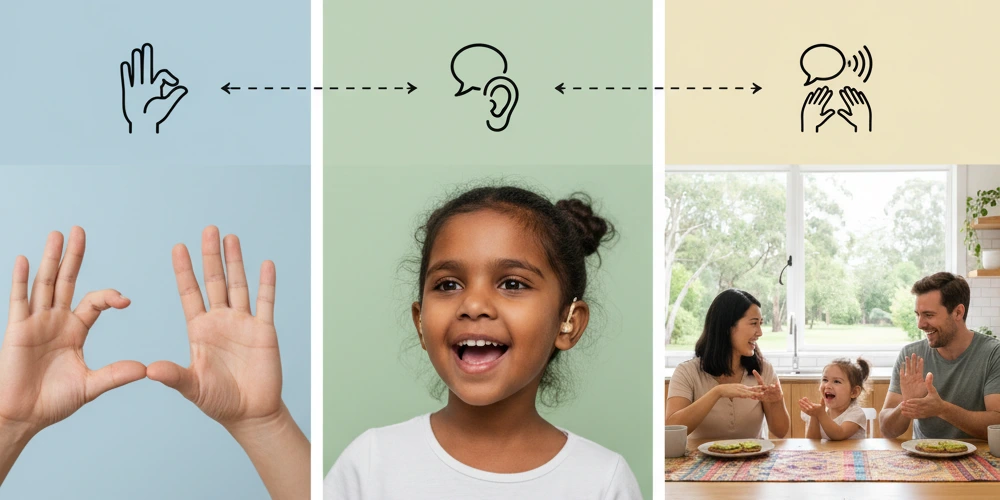
One of the most significant decisions facing families with a deaf or hard of hearing child is choosing a communication approach. This choice—whether to pursue Auslan, oral methods, or a combination of both—can feel overwhelming, particularly when you’re navigating new territory and receiving advice from multiple sources. The good news is that there’s no single “right” answer that works for every family and every child. The best approach is one that suits your child’s individual needs, your family circumstances, and your long-term goals.
This comprehensive guide explores the main communication methods available to Australian families, examines the strengths and considerations of each approach, and provides practical advice to help you make an informed decision that’s right for your family.
Understanding the Main Communication Approaches
Before diving into the details, it’s helpful to understand the broad categories of communication methods available in Australia. Each has its own philosophy, techniques, and outcomes.
Auslan and Sign Bilingualism
Sign bilingualism uses Auslan (Australian Sign Language) as the child’s first language, with spoken and/or written English learned as a second language. Auslan is a complete, natural language with its own grammar and syntax—it’s not simply signed English. The Aussie Deaf Kids website provides extensive resources for families considering this approach.
This method recognises that Auslan is fully accessible to deaf children because it doesn’t depend on hearing. Once a child develops strong Auslan skills, they can use this language foundation to learn English through reading, writing, and potentially speech if they’re interested and able.
Auditory-Oral Approaches
Auditory-oral methods focus on developing spoken language skills using residual hearing with hearing technology such as hearing aids or cochlear implants. These approaches emphasise listening, speechreading (lipreading), and spoken communication, without the use of sign language.
There are two main variations:
Auditory-Verbal Therapy (AVT): This intensive approach teaches children to use their remaining hearing to develop spoken language, with an emphasis on listening skills. Visual cues like lipreading are minimised, and sign language is not used. The goal is for the child to communicate primarily through listening and speaking.
Auditory-Oral Approach: Similar to AVT but incorporates lipreading, facial expressions, and natural gestures alongside listening skills. While sign language isn’t used, this approach acknowledges that visual information can support understanding.
Total Communication
Total communication is a philosophy rather than a specific method. It advocates using all available means of communication to help the child be successful. This might include speech, lipreading, hearing technology, sign language (often Signed English rather than Auslan), gestures, and visual aids. The specific combination is adapted to each child’s needs and preferences.
Combined or Bimodal Approaches
Some families choose to use both sign language and spoken language, often called a bimodal or combined approach. This might involve using Auslan in some contexts and spoken English in others, or using both simultaneously in certain situations. The NDIS guidelines acknowledge that many families successfully use combined approaches.
Factors to Consider When Making Your Choice
No decision about communication should be made in isolation. Multiple factors influence which approach might work best for your family.
Your Child’s Individual Profile
Every deaf child is unique. Consider:
Degree of Hearing Loss: Children with profound hearing loss may find visual language (Auslan) more naturally accessible, while children with mild to moderate hearing loss might develop spoken language more easily with hearing technology. However, these are generalisations—many profoundly deaf children successfully use spoken language with cochlear implants, and children with residual hearing may prefer or benefit from sign language.
Age at Diagnosis: Children identified early (through newborn hearing screening) and fitted with hearing technology quickly may have different trajectories than children identified later. Early intervention, regardless of the method chosen, consistently shows better outcomes.
Additional Needs: Some children may have other developmental considerations or additional disabilities that influence which communication method is most accessible to them.
Temperament and Learning Style: Some children naturally lean towards visual learning, while others respond well to auditory input. Observing your child’s preferences and strengths can guide your decision.
Family Circumstances
Your family situation matters significantly:
Communication Preferences: If your family is hearing and everyone uses spoken English, you might feel more comfortable with oral approaches. However, many hearing families successfully become fluent in Auslan and deeply value being part of the Deaf community.
Time and Commitment: Different approaches require different time investments. Auditory-verbal therapy often involves intensive daily practice sessions. Learning Auslan requires the entire family to commit to learning a new language. Be realistic about what your family can sustain long-term.
Access to Support Services: Your geographical location affects access to Auslan teachers, speech therapists, cochlear implant clinics, and Deaf community groups. Rural and regional families may face different options than those in major cities.
Cultural Values: Some families are drawn to the Deaf community and Deaf culture, valuing bilingualism and biculturalism. Others prioritise integration into mainstream hearing environments. Neither choice is superior—they simply reflect different values and goals.
Goals and Expectations
What do you hope for your child’s future? Consider both short-term and long-term goals:
- Effective communication with family members
- Access to the Deaf community and Deaf culture
- Success in mainstream education
- Employment opportunities
- Social connections with both deaf and hearing peers
- Independence and self-advocacy skills
Remember that goals may evolve over time as your child grows and their preferences emerge.
Detailed Look at Each Approach
Sign Bilingualism: Using Auslan as a First Language
How It Works
In a sign bilingual approach, Auslan becomes the child’s primary language—their “first language” or L1. All family members learn Auslan and use it consistently at home. The child develops natural fluency in Auslan, just as hearing children naturally acquire spoken language from their parents.
Once the child has a strong foundation in Auslan (typically from birth through early childhood), English is introduced as a second language (L2). This happens primarily through reading and writing, though some children may also develop spoken English skills if they’re interested and it’s accessible to them.
Advantages
Full Language Access: Auslan is completely accessible through vision, meaning a deaf child can acquire it as naturally and fully as a hearing child acquires spoken language. There’s no struggling to hear unclear sounds or missing parts of conversations.
Early Communication: Babies can start signing earlier than they can speak, which means earlier communication, reduced frustration, and stronger parent-child bonding during critical early years.
Cognitive Development: Having full language access from birth supports cognitive development, abstract thinking, literacy, and learning across all domains.
Cultural Identity: Auslan connects children to the Australian Deaf community, providing role models, cultural identity, and a sense of belonging. Deaf adults who use Auslan can serve as mentors and examples of successful deaf individuals.
Foundation for English: Research shows that strong skills in a first language (Auslan) actually support learning a second language (English). Concepts learned in Auslan transfer to English literacy.
Considerations
Family Learning Commitment: For hearing families, learning Auslan is a significant undertaking. Achieving conversational fluency takes time—typically several years of consistent study and practice. Until family members are fluent, communication may be limited.
Availability of Fluent Models: Children need exposure to fluent Auslan users, ideally Deaf adults who are native signers. This may require connecting with the Deaf community, attending Deaf events, or hiring Deaf tutors.
Educational Resources: While more schools now offer bilingual education programs, they’re not universally available. You may need to advocate strongly for appropriate educational support or consider specialised schools.
Mainstream Integration: In predominantly hearing environments without interpreters, communication can be challenging. Your child will need interpreters for many situations, and not all venues provide them readily.
Auditory-Oral Approaches: Developing Spoken Language
How It Works
Auditory-oral approaches maximise use of hearing technology (hearing aids or cochlear implants) to help children develop listening and spoken language skills. Children participate in therapy sessions—often multiple times weekly—to develop their ability to discriminate sounds, understand speech, and produce clear speech themselves.
Families practice listening and speaking activities throughout the day, creating a rich auditory environment. The approach relies heavily on consistent use of well-maintained hearing technology.
Advantages
Integration with Hearing World: Children who develop strong spoken language skills can communicate easily with the majority of people around them, potentially making everyday interactions simpler.
Family Communication: If your family uses spoken English, this approach allows direct communication without everyone learning a new language.
Educational Options: Children with strong oral skills can often attend mainstream schools with minimal support, accessing the same curriculum as their hearing peers.
Employment Opportunities: Spoken language skills can open doors in workplaces where sign language interpreters might not be available.
Considerations
Requires Good Hearing Technology Access: Success depends heavily on early diagnosis, prompt fitting of hearing aids or cochlear implants, and consistent use of well-maintained technology. Not all children achieve the same level of benefit from hearing technology.
Intensive Therapy Required: Oral approaches typically demand intensive speech therapy, sometimes daily practice sessions, and constant attention to auditory learning throughout the child’s day. This requires significant time, energy, and often financial resources.
Individual Variation: Even with optimal technology and therapy, not all children develop clear, easily understood speech. Factors like degree of hearing loss, age at intervention, individual aptitude, and family support all influence outcomes.
Potential Language Delays: Learning spoken language through imperfect hearing is harder than learning it through normal hearing. Some children experience language delays while developing oral skills, which can impact literacy, learning, and emotional development.
Social-Emotional Considerations: Children may experience frustration during the long process of developing speech skills. Some report feeling isolated from Deaf peers who use sign language, while also feeling “different” from hearing peers.
Total Communication: Using All Available Tools
How It Works
Total communication embraces flexibility, using whatever communication methods work best for each child in each situation. This might include Signed English (signs in English word order), fingerspelling, spoken language, lipreading, gestures, visual aids, hearing technology, and written communication.
The approach is highly individualised and adapted based on the child’s needs, preferences, and the communication demands of different situations.
Advantages
Flexibility: You can adapt communication to what works best in each moment and context, rather than rigidly adhering to one method.
Reduced Pressure: There’s less pressure to “succeed” at one specific approach. If speech isn’t clear, signs can fill in. If signs aren’t understood, speech or writing can clarify.
Multiple Pathways: Children can develop skills in both visual and auditory communication, potentially giving them more options for connecting with different people.
Considerations
Potential Confusion: Critics argue that using multiple methods simultaneously (like speaking while signing) can muddy language development. You’re not providing a clear model of either spoken English or Auslan.
Neither Language Fully Developed: Some research suggests children using total communication may not develop native-like proficiency in either spoken English or Auslan, potentially leaving them without full access to any complete language.
Sign System Limitations: Signed English (used in many total communication programs) is not a natural language like Auslan. It’s an artificial system designed to represent English visually, which can be awkward and doesn’t reflect how Deaf people naturally communicate.
Combined Approaches: The Best of Both?
How It Works
Some families successfully use what’s called a bimodal bilingual approach—developing both Auslan and spoken English as separate, complete languages. Rather than using them simultaneously (which can compromise both), they’re used at different times or in different contexts.
For example, a family might use Auslan at home for full communication access, while the child also attends speech therapy and uses spoken language at school. The key is language separation—using each language fully and correctly in its appropriate context, rather than mixing them.
Advantages
Comprehensive Communication: Children develop two complete language systems, giving them maximum flexibility to communicate with both deaf and hearing people.
Language Security: If one approach proves challenging (for example, if spoken language doesn’t develop as hoped), the child still has full communication access through Auslan.
Cultural Biculturalism: Children can participate in both Deaf and hearing worlds, accessing both cultures and communities.
Family Communication: Provides ways for all family members to communicate successfully, whether they’re more comfortable with spoken language or sign language.
Considerations
Significant Resource Investment: Developing proficiency in two languages requires double the effort—Auslan classes for the family, speech therapy for the child, and time commitment for both.
Consistency Required: Success depends on clear language separation and consistent use of each language. Mixing them or using one half-heartedly can compromise both.
Potential Identity Questions: Some children navigate their identities easily between two cultures; others may struggle with feeling caught between two worlds or not fully belonging to either.
Making Your Decision: Practical Steps
Gather Information
Talk to Professionals: Consult with audiologists, speech pathologists, teachers of the deaf, and Deaf educators. Seek opinions from multiple sources with different perspectives.
Meet Other Families: Connect with families using different approaches. Ask about their experiences—both successes and challenges. First-hand stories provide invaluable insights.
Connect with Deaf Adults: Deaf adults who grew up with different communication approaches can share their lived experiences. Their perspectives on what worked and what they wished had been different can be enlightening.
Research Outcomes: While research can’t predict your individual child’s outcome, understanding general trends and evidence can inform your decision. Look for quality research from reputable sources.
Start Somewhere
Choose a Starting Point: You don’t have to make a permanent, unchangeable decision today. Choose an approach that makes sense now, commit to it fully, and reassess as you go.
Be Consistent: Whatever you choose, consistency matters more than the specific method. Children need clear, rich language input—whether visual, auditory, or both.
Give It Time: No approach shows overnight results. Communication development takes years. Allow enough time to fairly assess whether your chosen approach is working before making major changes.
Stay Flexible and Child-Centered
Follow Your Child’s Lead: Watch how your child responds. Are they engaged? Frustrated? Thriving? Your child’s experience should guide adjustments.
Be Willing to Adapt: The “right” choice at age one might not be the right choice at age five or fifteen. Your child’s needs, abilities, and preferences will evolve. Be open to changing course if necessary.
Avoid Ideology: Sometimes parents or professionals become rigidly attached to one approach for ideological reasons. Always prioritise your child’s wellbeing and communication success over adherence to a particular philosophy.
Include Your Child: As your child grows, include them in decisions about their communication. Their voice matters most.
Common Myths and Misconceptions
Myth: “If you use sign language, the child won’t develop speech.”
Reality: Research shows that sign language doesn’t prevent speech development. Many children use both successfully. Early sign language can actually reduce frustration and support overall language development, creating a foundation that helps with spoken language later if pursued.
Myth: “With modern technology, deaf children don’t need sign language anymore.”
Reality: While hearing technology has advanced dramatically, it doesn’t give “normal” hearing. Many children with cochlear implants benefit from sign language, either as a primary language or as a backup. Technology can fail, and even optimal technology doesn’t provide the same quality of hearing as typical hearing.
Myth: “You have to choose one approach and stick with it forever.”
Reality: Families can and do change approaches based on what’s working. While consistency is valuable, being responsive to your child’s needs matters more than rigid adherence to one method.
Myth: “Oral approaches work for all children if the family just tries hard enough.”
Reality: Individual differences mean that despite best efforts, optimal technology, and intensive therapy, some children don’t develop functional spoken language. This isn’t a failure of the child or family—it’s simply reality. Having a backup plan (like sign language) protects the child’s language development.
The Bottom Line: Your Child’s Language Access Matters Most
Regardless of which communication approach you choose, the most critical factor is that your child has full, rich language access from the earliest possible age. Language deprivation—growing up without full access to any complete language—has serious consequences for cognitive development, literacy, emotional wellbeing, and life outcomes.
Whether through Auslan, spoken English, or both, ensure your child can:
- Understand fully what’s being communicated to them
- Express their thoughts, needs, feelings, and ideas completely
- Engage in complex conversations about abstract concepts
- Access education, stories, and learning
- Develop relationships with family, peers, and the broader community
The best communication approach is the one that works for your unique child and family—the one you can implement consistently, that gives your child full language access, and that supports their development into a confident, communicating individual.
Trust yourself to make this decision. Gather information, consider your circumstances, listen to your child, and choose a path forward. You can always adjust along the way. The fact that you’re reading this article shows you care deeply about your child’s communication—and that’s what matters most.